InfiniBand network adapters play a vital role in building future computing architectures due to their advantages of high bandwidth, low latency, RDMA support, scalability, flexible topology, efficient CPU offload, high reliability, and a wide range of application scenarios.
Here are a few key benefits of InfiniBand network adapters:
- High bandwidth and low latency
- High bandwidth: InfiniBand network adapters support extremely high data transfer rates, currently up to hundreds of Gbps, far exceeding traditional Ethernet. This high bandwidth makes InfiniBand ideal for handling large-scale data transfers and compute-intensive tasks.
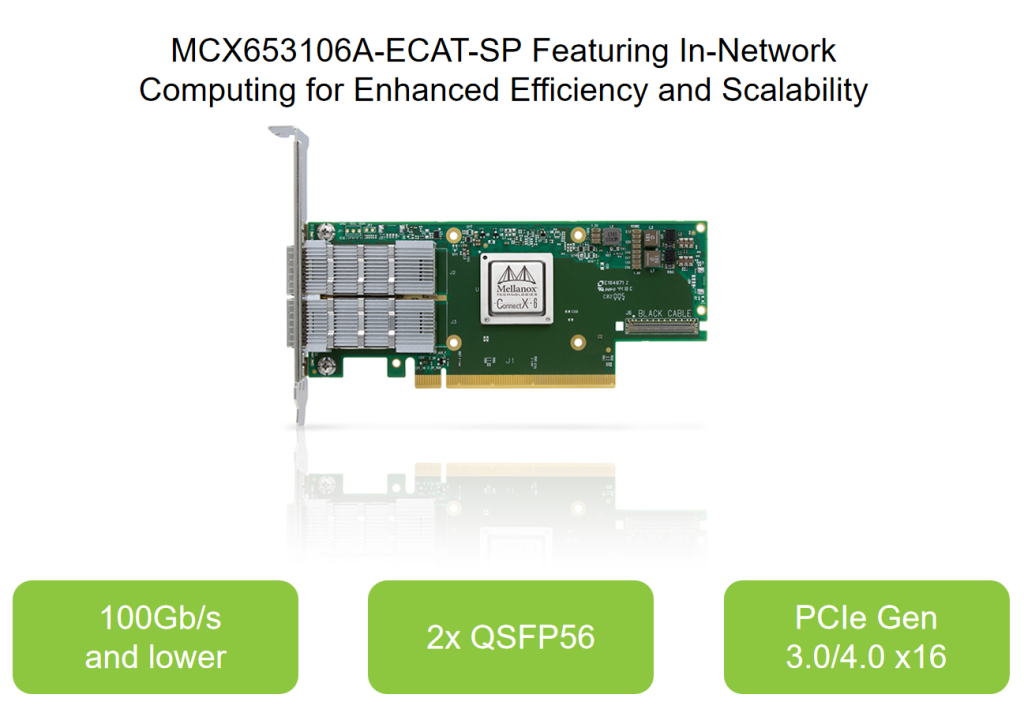
- Low latency: InfiniBand is designed to optimize the latency of data transmission, which can be as low as microseconds, which is much lower than that of Ethernet. This is critical for applications that require fast response and real-time processing.
- Remote Direct Memory Access (RDMA)
The InfiniBand network adapter supports RDMA technology, which allows data to be transferred directly between the memory of two computers without going through CPU processing. This technology greatly reduces communication latency and improves data transmission efficiency, and is especially suitable for massively parallel computing and distributed storage systems.
- Scalability
- Network scale: InfiniBand networks support the construction of large and complex network topologies, with up to tens of thousands of nodes deployed in a single subnet. This scalability makes the InfiniBand network easily capable of handling the demands of large data centers and high-performance computing clusters.
- Technology upgrades: As technology continues to advance, so does the speed and performance of InfiniBand networks. From SDR, DDR, QDR to FDR, EDR, HDR, and more, InfiniBand networks have made a quantum leap in speed and will continue to grow in the future.
- Flexible topology
InfiniBand networks support a variety of topologies, including point-to-point, tree, ring, and mesh. This flexibility allows InfiniBand networks to be adapted to computing environments of different sizes and needs. Whether it's a small lab environment or a large data center, InfiniBand has the right networking solution.
- Efficient CPU offloading
The InfiniBand network architecture maximizes the efficiency of the CPU by offloading protocol processing and data movement from the CPU to the interconnected devices. This allows the CPU to focus on performing computing tasks rather than dealing with network communications, improving overall system performance.
- High reliability and availability
- Redundant design: InfiniBand networks typically use a redundant mesh topology to provide high availability and fault tolerance. This design ensures that the network can function properly even if some nodes or links fail.
- Self-healing networking: Some InfiniBand solutions also offer self-healing networking capabilities that can quickly restore connectivity in the event of a link failure, reducing the risk of downtime and data loss.
- Wide range of application scenarios
InfiniBand network adapters are widely used in high-performance computing applications such as supercomputers, AI, and cloud computing environments. In these areas, where computing performance and network performance requirements are extremely high, InfiniBand networking is the network solution of choice due to its superior performance and flexibility.
In summary, InfiniBand network adapters play a vital role in building future computing architectures due to their advantages of high bandwidth, low latency, RDMA support, scalability, flexible topology, efficient CPU offload, high reliability, and a wide range of application scenarios.


