There are significant differences between InfiniBand network adapters and Ethernet in a number of ways, including performance, application scenarios, technical features, and network architecture.
There are significant differences between InfiniBand network adapters and Ethernet in a number of ways, including performance, application scenarios, technical features, and network architecture. Here are the main differences between them:
- Performance differences
- Bandwidth and Latency:
- InfiniBand: Provides extremely high data transfer bandwidth, from 10Gbps to 200Gbps today and beyond (such as 1600Gbps GDR and 3200Gbps LDR in the future) with extremely low latency, typically in the microsecond range. This high bandwidth and low latency make it ideal for applications that require high-speed data transfer and real-time response.
- Ethernet: While Ethernet bandwidth is also increasing, from 10Mbps to 100Gbps, 200Gbps and beyond, its latency is higher than that of InfiniBand, typically between microseconds and milliseconds.
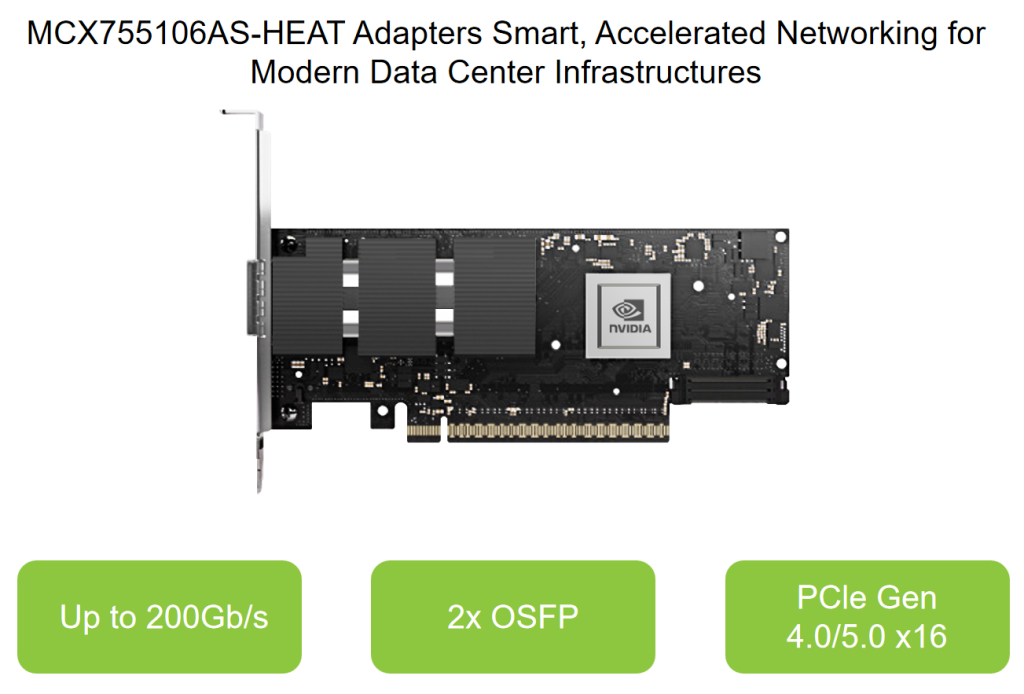
- Remote Direct Memory Access (RDMA):
- InfiniBand: Supports RDMA technology, which allows data to be transferred directly between the memory of two computers without going through CPU processing, further reducing latency and improving data transfer efficiency.
- Ethernet: Traditional Ethernet does not support RDMA, and data transmission needs to be intervened by the CPU, which may become a bottleneck in some high-performance application scenarios. However, with the development of technology, some Ethernet solutions have also begun to support RDMA, such as RoCE (RDMA over Converged Ethernet).
- Differences in application scenarios
- InfiniBand: It is mainly used in high-performance computing (HPC), data-intensive applications, and latency-sensitive scenarios, such as supercomputers, AI computing clusters, and financial transaction systems. These scenarios have extremely high requirements for the speed and latency of data transmission.
- Ethernet: It is widely used in various scenarios such as local area networks (LANs), cloud computing, smart cities, and data centers. Due to its maturity, cost-effectiveness, and good interoperability, Ethernet has become the technology of choice for most network environments.
- Differences in technical characteristics and network architecture
- Topology:
- InfiniBand: Supports multiple topologies, such as ring, star, and tree, to meet network requirements of different scales. Its network architecture includes multiple layers, such as the physical layer, the link layer, the network layer, and the transport layer.
- Ethernet: Multiple topologies such as star, bus, and mesh are also supported. Ethernet is mainly based on the IEEE 802.3 standard, which defines the CSMA/CD bus media access control sublayer and physical layer specifications.
- Scalability and Flexibility:
- InfiniBand: Excellence in scalability and flexibility, capable of supporting network deployments of tens of thousands of nodes, with flexible network configuration and expansion based on demand.
- Ethernet: It is also scalable, but as the network grows, it may require more management and configuration work.
- Cost & Maintenance:
- Ethernet: Due to its maturity, stability, and cost-effectiveness, Ethernet is relatively low-cost and easy to maintain and manage. This makes Ethernet the preferred choice for large-scale deployments and low-cost solutions.
- InfiniBand: While InfiniBand offers significant performance advantages, it is relatively expensive to wear and requires specialized technicians to maintain and manage. Therefore, factors such as cost and resource investment need to be considered when choosing an InfiniBand.
In summary, there are significant differences between InfiniBand network adapters and Ethernet in terms of performance, application scenarios, technical features, and network architecture. When choosing network technology, enterprises need to consider and weigh the actual needs comprehensively.


